
Howard County Court Records After Arrest
Criminal court records after a Howard County jail arrest begin with the filing process, not with the act of booking alone. A deputy, Cresco Police officer, municipal officer, or other authority may bring a person to the Howard County Law Enforcement Center. Jail staff handle the custody side, such as intake, release status, and holds. The court record starts when the case is filed in Iowa's state court system and the docket begins to show charges, case events, parties, lawyers, fines, fees, and dispositions.
The Howard County Attorney's Office is central to that path. County Attorney Kevin Schoeberl is listed as the county attorney, and the official office page says criminal prosecution is a primary duty. It also says that, except for simple misdemeanors, charging decisions rest with the prosecutor. That means an arrest charge or jail intake reason can differ from the court charge later filed by the prosecutor.
The custody side still matters. Current jail status, booking questions, and release timing belong with Howard County jail inmate records. Booking photos, if sought, belong with Howard County jail mugshot records. The court record is the filed case, and it should be checked through Iowa Courts Online or through the clerk in the filing county.
Arrest to Howard County Court Records
The usual path is arrest, jail booking, release or hold review, prosecutor charging review, then court filing. The official Howard County Law Enforcement Center page says people held locally may be awaiting trial or sentencing, may be serving short county sentences, or may have been brought in by surrounding municipalities, Cresco Police, or accepted U.S. Marshals cases. It also says some people are released after bail, pretrial services, probation supervision, or release on their own recognizance.
- An arrest or warrant brings the person into custody, often through the Howard County Sheriff's Office, Cresco Police Department, another local agency, or another authority.
- Jail booking occurs at the Howard County Law Enforcement Center when the person is held locally.
- Bond, recognizance release, pretrial supervision, or another hold determines whether the person leaves custody quickly.
- The Howard County Attorney reviews the matter and decides how most non-simple-misdemeanor charges should be filed.
- The filed case appears in Iowa Courts Online when public docket information is available.
- Public documents, when available for viewing, can be checked at a courthouse public terminal in the county where the case was filed.
This sequence explains why a court records after arrest search may fail on the same day as a booking. A jail may know that a person is in custody before the prosecutor has filed the formal charge. Once the case is filed, the docket is the better record for charge status, hearings, fines, fees, and disposition.
Search Howard County Court Records
Iowa Courts Online search is the statewide public docket entry point for Howard County criminal cases. The Iowa Courts Online landing page states that public docket access is free and does not require a subscription or registration. The docket is maintained by clerk offices across the state, so a Howard County case can be searched through the same portal used for other Iowa counties.
The official Iowa Courts Online guide says public docket information can include case titles, filings, party and lawyer names, criminal charges, dispositions, fines and fees owed, and fine or fee payments. It is not a live county jail roster. It is also not a mugshot gallery. For case documents rather than docket entries, the court source says public documents are viewed at a courthouse public access terminal in the county where the case was filed.
| Field or Control | Type | Required | How to Use It |
|---|---|---|---|
| Click Here to Search | Link | n/a | Opens the statewide public docket search. |
| Defendant or party name | Search | Unspecified | Use the full legal name and compare case dates before assuming a match. |
| Case number | Search | Unspecified | Best when known from a complaint, citation, clerk notice, or bond paper. |
| County | Filter | No | Narrow to Howard County when the search returns statewide matches. |
| Case type | Filter | No | Use criminal or traffic categories where the portal exposes them. |
| Public terminal | In person | n/a | Use the courthouse terminal for public case documents in the filing county. |
The official Iowa Judicial Branch Howard County court page gives the local court contact path. The Howard County Clerk of Court and Magistrate are at the courthouse on North Elm Street in Cresco, and the research confirms the clerk phone as (563) 547-9206.
Charging Documents After Arrest
Charges do not all enter court records in the same form. A complaint may start a case, an information may be filed by the prosecutor in many felony matters, and an indictment comes from a grand jury. The research glossary identifies each as a charging document. The important point for Howard County court records after a jail arrest is that the filed document controls the court case. A booking reason is not the final word on what the court will track.
| Document | Who Files It | What It Does | Howard County Use Point |
|---|---|---|---|
| Complaint | Officer or prosecutor | Can start a criminal case with the alleged offense. | Often the first court filing tied to the arrest path. |
| Information | Prosecutor | Sets out prosecutor-filed charges in many non-indictment felony cases. | Reflects the County Attorney's charging decision. |
| Indictment | Grand jury | Charges a case through grand-jury action. | Less common, but still a court charging record. |
The County Attorney page matters here because it explains the prosecutor's role in deciding whether and how to pursue charges beyond simple misdemeanors. It also states that the County Attorney does not give private legal advice. A defendant, victim, or family member who needs legal advice should use a lawyer, while public case status should be checked through the court docket or clerk.
Howard County Charge Status
A charge can change after the first filing. It may remain pending, be amended, be reduced, be dismissed, or end in a disposition such as a plea, conviction, acquittal, deferred judgment, or dismissal. Iowa Courts Online is useful because the docket can show charge descriptions, case dates, disposition entries, fines, fees, and payments when public. A name search should still be checked with care because statewide results can include people with similar names.
| Status | Meaning | Why It Matters After Arrest |
|---|---|---|
| Pending | The charge has been filed and remains open. | Future hearings, release terms, and deadlines may still change. |
| Amended | The filed charge was changed by later court action. | The court record may no longer match the original booking allegation. |
| Reduced | The charge level or offense was lowered. | The final outcome may be less severe than the arrest allegation. |
| Dismissed | The charge was ended without a conviction on that count. | A dismissal is not the same as a conviction. |
| Disposed | The court has entered an outcome. | Read the disposition line, not just the original charge label. |
For background checks beyond the live docket, Iowa.gov identifies the Iowa criminal history background check route through the Division of Criminal Investigation and lists a $15 fee. That state history check is separate from a free docket search and separate from the county jail's custody information.
Bond Records After Howard Arrest
Bond and release information sits between jail custody and court records. The Howard County LEC page says detainees may be released after putting up bail, released to pretrial services, placed under probation supervision, released on their own recognizance, or held for court appearance. The county sources do not publish a local bond schedule, online bond-payment portal, accepted payment list, or direct bond desk hours.
For a current case, bond should be confirmed through the Howard County Sheriff's Office or LEC at (563) 547-3535 and through the Clerk of Court or Magistrate at (563) 547-9206 once a court order exists. Iowa Courts Online may show case number, bond-related entries, hearings, and later disposition. If another agency hold exists, posting a Howard County bond may not lead to release.
| Release Type | How It Works | Local Source Status |
|---|---|---|
| Cash bond | A cash amount must be posted before release. | Payment methods are not published by the county sources inspected. |
| Surety bond | A third-party surety arrangement may be used when allowed by the court order. | Local surety rules must be confirmed with the clerk or jail. |
| Own recognizance | Release based on a promise to appear and follow conditions. | The LEC page says some detainees are released this way. |
| Pretrial supervision | Release with supervision conditions before the case is over. | The LEC page names pretrial services as a release path. |
| No-bond hold | Release is blocked until another court or agency issue is resolved. | Confirm with the jail, court, or holding agency. |
Howard County Warrants and Holds
No official Howard County active-warrant search page, public warrant list, most-wanted list, or sheriff mobile warrant tool was located in the county sources. The sheriff's office enforces laws, serves court orders and civil process, and operates the local jail, but the inspected official pages do not provide a searchable warrant database. A warrant question tied to current custody should start with the Sheriff's Office phone line.
- Arrest warrant
- A court order authorizing arrest in a criminal matter.
- Bench warrant
- A court order often issued after a missed court date or violation of a court order.
- Search warrant
- A court order authorizing a search, not a jail custody list.
- Detainer or hold
- A request or order from another agency that can stop release even when local bond is posted.
Court records can show failures to appear, bond forfeitures, warrant-related entries, and later case action once public. Active warrants and sensitive law-enforcement records may be limited by Iowa Code chapter 22 confidentiality exceptions, so a public-records request may not produce every item.
Charges vs Convictions
A jail arrest can lead to a charge, but a charge is still an accusation. A conviction requires a guilty plea, verdict, or other qualifying court outcome. Court records after a Howard County jail arrest should be read by stage: the arrest explains why the person entered custody, the charge states what was filed, and the disposition states how the case or count ended.
| Point of Comparison | Charge | Conviction |
|---|---|---|
| Case stage | An alleged offense filed in court. | A final result after plea, verdict, or qualifying judgment. |
| Proof level | Based on accusation and legal filing standards. | Requires the court outcome needed for conviction. |
| Docket reading | Look at the charge list and amendments. | Look at the disposition for each count. |
| Risk of confusion | May be mistaken for guilt if read alone. | Shows the court's outcome on the filed count. |
Sealed vs Expunged Records
Iowa public-records law starts with a right to examine and copy public records, but not all law-enforcement and court information stays open. Iowa Code 22.2 states the general right of access, while Iowa Code 22.7 lists confidential record exceptions. Juvenile matters, sealed case records, active investigative material, medical information, and other protected records may be withheld or redacted.
| Record Result | Plain Meaning | Search Impact |
|---|---|---|
| Sealed | Public access is restricted by court rule, statute, or order. | The case or document may not appear in the same public way. |
| Expunged | Eligible records are removed from public access under the governing process. | A public search may no longer show the same arrest or case record. |
| Redacted | Some parts are hidden while other parts remain public. | Names, protected facts, or documents may be partly withheld. |
Expungement is not automatic for every dismissal or deferred outcome. It is a legal process with eligibility rules. The County Attorney's Office does not provide private legal advice, so questions about clearing or sealing a record should go to a lawyer or the clerk for filing procedure, not to the prosecutor for personal representation.
Howard County Court Source
The official Iowa Courts Online landing page describes free public docket access for Iowa court records.
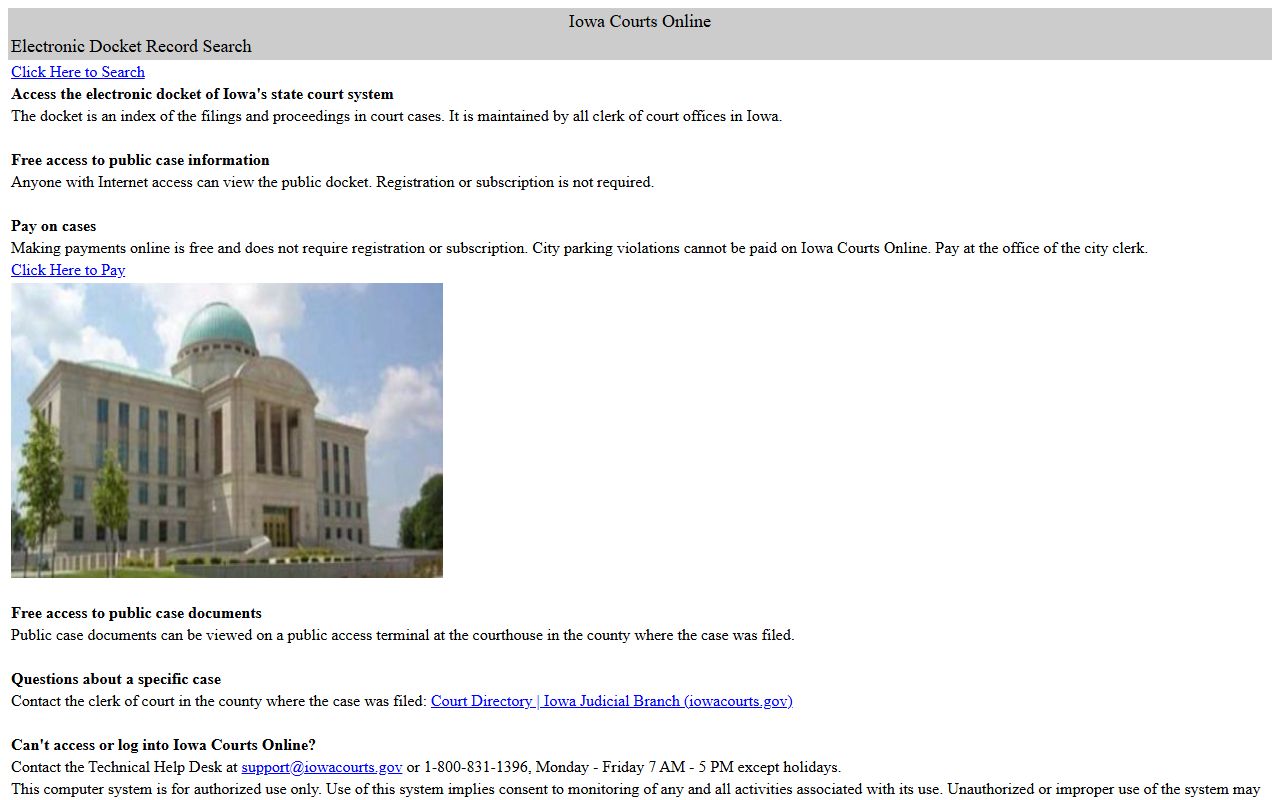
Use the court portal for filed Howard County charges and case status, then use the courthouse terminal or clerk when a public case document is needed instead of a docket entry.
Restricted Howard Court Records
Restricted court records after an arrest require careful handling. Iowa Code chapter 22 defines broad public-record access, but it also works with other laws that make certain records confidential. A person searching Howard County court records should not assume that every arrest, filing, document, juvenile matter, dismissed charge, investigative record, or protected party detail will be visible online.
The best official route depends on the record type. Use Iowa Courts Online for docket entries, the Howard County Clerk of Court or Magistrate for filed case questions and public terminals, the Sheriff's Office for current custody or jail booking questions, and the Iowa DCI background-check path for a statewide criminal history request. Each channel answers a different question.
Important: Public docket data may be incomplete, restricted, or changed by later court action; verify case details with the clerk.